
Loading market layer

Loading market layer
HyperArbi is designed as a complete cross-exchange operating layer: data normalization, AI-assisted opportunity intelligence, executable-edge validation, smart routing, treasury coordination, security controls and operational observability.
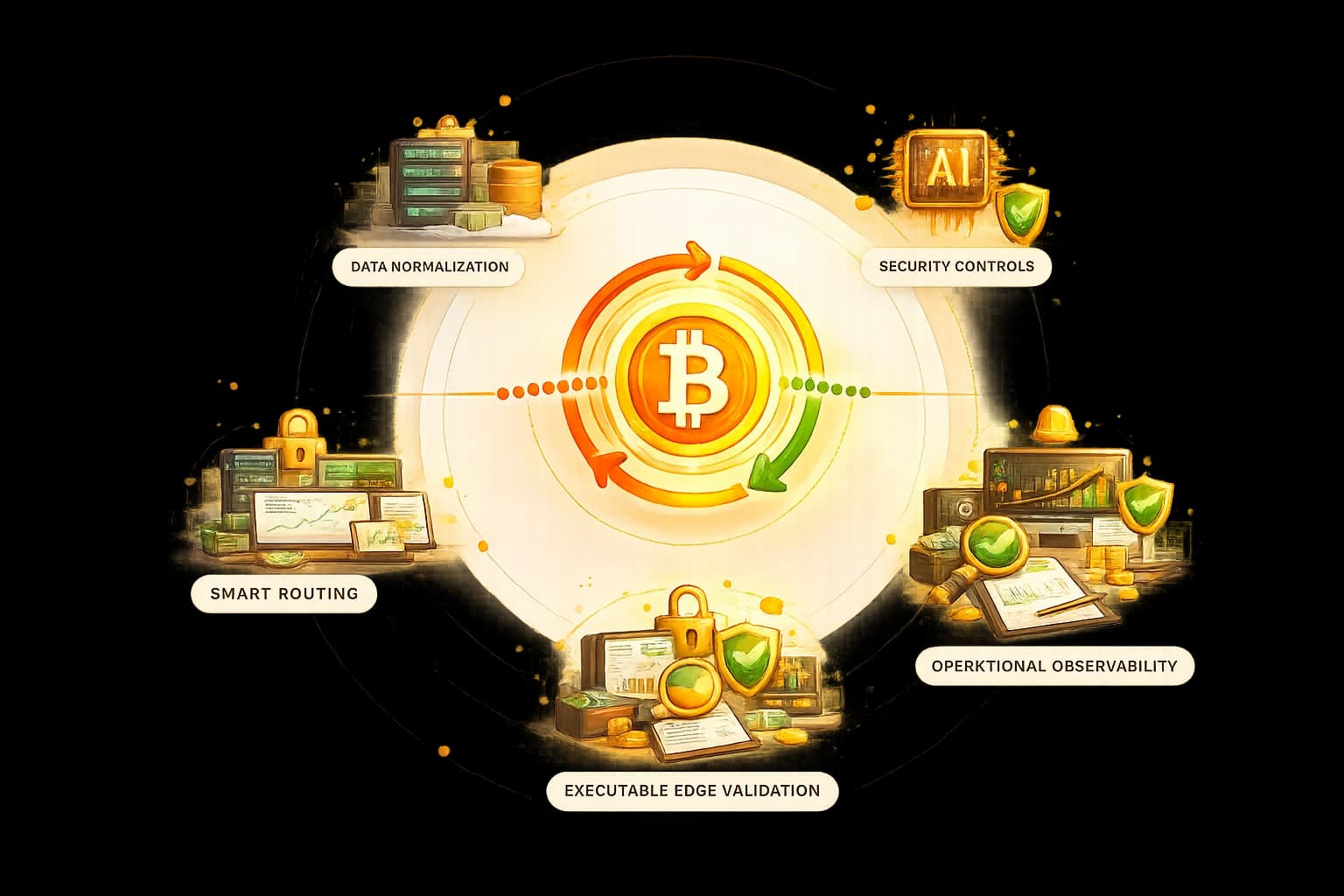
The difference is not only how an opportunity is detected, but how data, costs, capital, execution, settlement and monitoring are coordinated around it.
| Capability | HyperArbi | Basic spread scanner | Single-venue trading bot | Manual arbitrage workflow |
|---|---|---|---|---|
01Market coverage | Cross-exchange connectivity with normalized order books and liquidity data | Usually displays headline price differences only | Limited to one exchange and one internal strategy environment | Depends on the operator monitoring venues independently |
02Opportunity intelligence | AI-assisted spread, volatility, liquidity and anomaly analysis | Rule-based alerting with limited context | Strategy rules focused on one venue | Human comparison and interpretation |
03True cost calculation | Fees, slippage, network costs, depth and execution overhead included before approval | Often compares visible prices before all costs | Accounts for venue fees but not cross-venue settlement complexity | Requires separate calculations and constant updating |
04Execution coordination | Smart routing, timing, lifecycle management and settlement coordination | Typically alerts the user but does not coordinate both legs | Automates orders on one venue only | Operator submits and tracks each order independently |
05Incomplete-order handling | Timeouts, partial-fill management, retry and recovery workflows | Usually outside the scanner workflow | Limited to venue-specific order handling | Dependent on operator reaction time |
06Capital coordination | Capital reservation, exchange inventory monitoring and liquidity balancing | No integrated treasury layer | Balance management limited to one venue | Balances tracked manually across accounts |
07Security and governance | Layered authentication, authorization, encryption, rate limiting and audit logging | Varies by provider and is often not visible | Relies heavily on the exchange security model | Security depends on user practices across every account |
08Operational visibility | KPIs, health monitoring, alerts, reports and immutable decision records | Primarily opportunity alerts | Trade history and strategy status | Spreadsheets, exchange histories and manual reconciliation |
HyperArbi improves reliability by making every stage explicit, measurable and observable rather than depending on a single alert or opaque strategy loop.
HyperArbi validates timestamps, stream health and normalized market structure before an opportunity can enter evaluation.
The engine qualifies opportunities only after depth, fees, slippage, latency and capital availability are considered.
Routing, timeouts, partial fills, retries, settlement and recovery are treated as one connected workflow.
Capital allocation, venue inventory and liquidity balancing remain visible to the decision and execution layers.
Authentication, authorization, encrypted credentials, rate limiting and audit events protect the operational surface.
System health, execution quality, alerts and decision records make the automation reviewable instead of opaque.